
What Is a Facial Tissue Packing Machine?
A Facial Tissue Packing Machine is industrial packaging equipment designed to wrap, seal, and prepare folded facial tissue products for storage, transportation, and retail distribution. It is commonly used in tissue paper factories, household paper converting plants, private-label tissue manufacturing facilities, and commercial tissue packaging operations.
In a typical facial tissue production line, large paper rolls are processed through folding equipment, cut into predetermined sizes, transferred to a packing machine, and wrapped in suitable packaging materials. Depending on the product specification, the finished tissues may be packaged in soft plastic film, individual bags, or carton-based retail packaging.
The packing stage is particularly important because it influences the appearance, consistency, protection, and handling of finished products. Poorly aligned wrapping, inconsistent sealing, or incorrect package dimensions can create unnecessary material waste and increase the number of rejected products.
A properly selected Facial Tissue Packing Machine can help manufacturers achieve more consistent packaging while improving production organization. Modern equipment may include programmable logic controllers, servo motors, automatic film feeding, product sensors, touch-screen interfaces, and integrated sealing systems.
However, not every factory requires the most advanced machine available. For a small facility producing several tissue sizes in limited quantities, a simpler packaging solution may be more practical. A larger manufacturer operating several shifts may benefit substantially from automated product transfer, continuous wrapping, and integrated downstream packaging.
Key Takeaway: The best Facial Tissue Packing Machine is not necessarily the fastest or most expensive model. The right choice depends on production capacity, packaging dimensions, available labor, factory layout, and the level of automation required.
Semi-Automatic vs Fully Automatic Facial Tissue Packing Machine Comparison
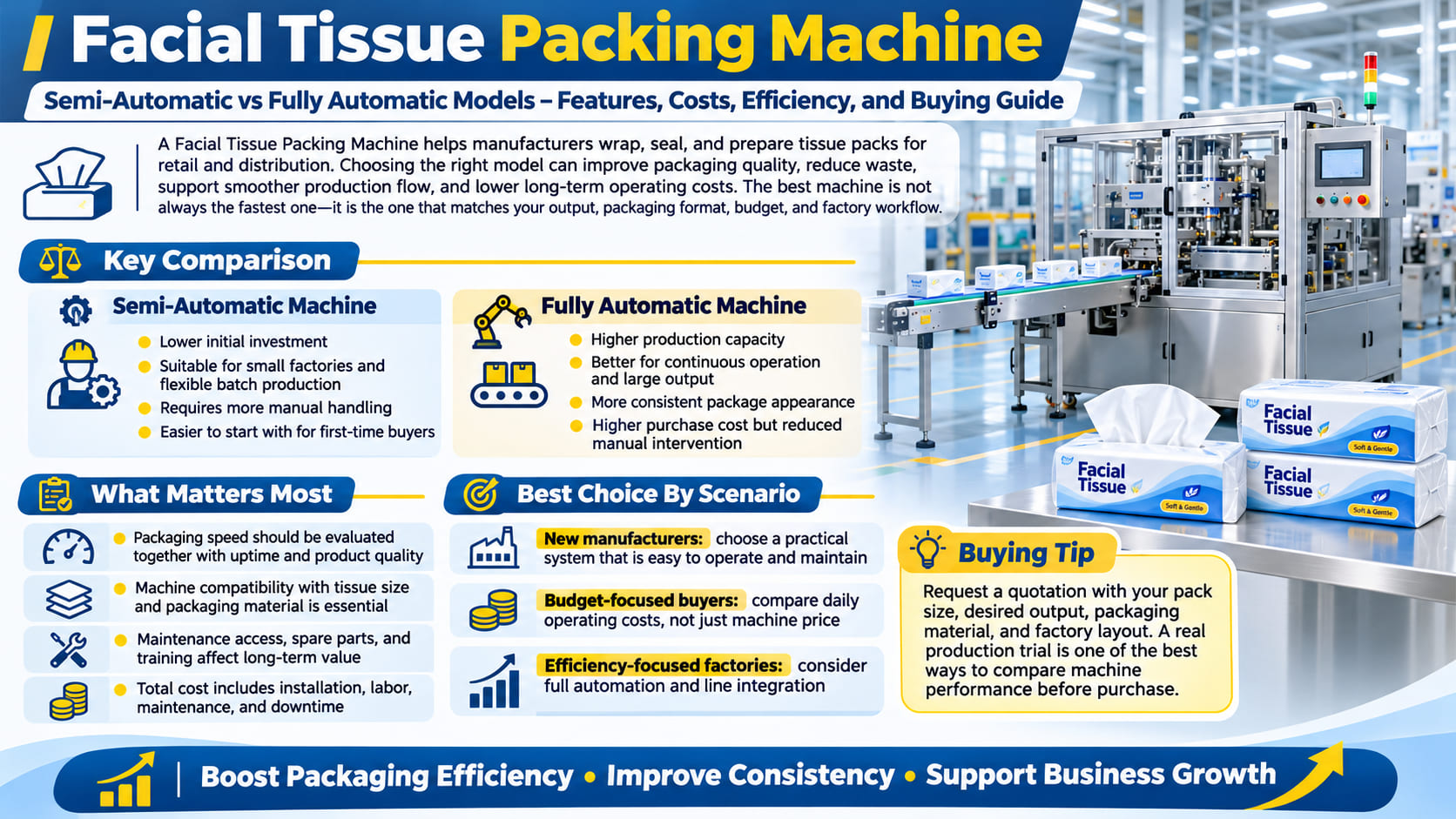
One of the most important purchasing decisions is whether to invest in semi-automatic or fully automatic facial tissue packaging equipment. Both solutions can support commercial tissue manufacturing, but they differ significantly in labor requirements, workflow integration, productivity, investment costs, and maintenance complexity.
Semi-automatic systems generally require an operator to perform one or more production steps, such as feeding products, positioning tissue stacks, or transferring completed packs. Fully automatic systems can coordinate these operations through conveyors, sensors, programmed controls, and mechanical handling equipment.
| Comparison Item | Semi-Automatic Machine | Fully Automatic Machine | Best For |
|---|---|---|---|
| Automation Level | Requires manual assistance during selected operations | Automated feeding, wrapping, sealing, and discharge where configured | Factories seeking different levels of labor reduction |
| Initial Investment | Generally lower equipment cost | Generally higher equipment and integration cost | Budget-conscious manufacturers |
| Production Capacity | Output depends heavily on operator involvement | Higher continuous output potential with suitable configuration | High-volume tissue manufacturers |
| Labor Requirements | More frequent manual handling | Reduced direct handling, but skilled supervision remains necessary | Factories facing labor constraints |
| Packaging Consistency | May vary with manual positioning and feeding | More repeatable settings when correctly calibrated | Retail brands requiring consistent pack appearance |
| Maintenance | Often simpler mechanical systems | More sensors, drives, and electronic control components | Factories with different technical support capabilities |
| Production Flexibility | Potentially convenient for small production batches | Can support multiple formats if changeover systems allow | Manufacturers with changing product specifications |
| Line Integration | May operate independently from upstream machinery | Can connect to folding, cutting, conveying, and bundling equipment | Factories developing integrated production lines |
| Long-Term Expansion | May require additional labor or equipment as demand grows | Better suited to scalable continuous production when properly sized | Growing tissue manufacturing businesses |
For companies entering the tissue manufacturing industry, semi-automatic packaging can provide a practical starting point. It allows manufacturers to establish production procedures without immediately committing to a complex automated system.
On the other hand, a fully automatic Facial Tissue Packing Machine may provide better long-term value for manufacturers processing thousands of packs every shift. The potential advantages include reduced direct labor requirements, more consistent product flow, and improved coordination between packaging stages.
Facial Tissue Packing Machine Efficiency: What Really Matters?
Packaging speed is one of the first specifications buyers notice. Manufacturers commonly advertise machine capacity in packs per minute, but this number should not be interpreted as guaranteed production under every operating condition.
Published specifications illustrate the range available in the market. IMAKO lists facial tissue wrappers with nominal outputs of approximately 100, 160, and 220 packages per minute across different models. Renix Machinery describes a seven-lane soft-pack facial tissue line with packaging capacity of approximately 100–160 packs per minute, depending on its production configuration.
These figures are manufacturer specifications rather than independently verified production guarantees. Actual output can vary with tissue dimensions, sheet counts, film characteristics, changeovers, operator skill, and equipment downtime.
Practical Example:
A machine operating at 100 packs per minute for eight hours has a theoretical capacity of 48,000 packs. If actual availability, operating speed, and quality yield combine to produce 75% overall efficiency, the resulting output would be approximately 36,000 acceptable packs. This is an illustrative calculation, not a guaranteed machine performance figure.
Another important consideration is line balancing. Installing a high-speed wrapper does not automatically increase production if the upstream folding or cutting equipment cannot supply enough tissue stacks. Similarly, finished packages may accumulate if downstream bundling or case-packing equipment operates too slowly.
Manufacturers should therefore evaluate packaging efficiency using acceptable finished packs per shift rather than maximum advertised speed alone. Relevant measurements include operating uptime, packaging rejection rates, film consumption, labor hours, product changeover time, and unplanned maintenance interruptions.
3 Buying Scenarios: Which Facial Tissue Packing Machine Fits Your Factory?
Scenario 1: Small Manufacturers and First-Time Buyers
A small tissue factory may prioritize manageable equipment costs, simple operation, and the ability to produce several packaging sizes. For this type of business, semi-automatic machinery or a compact automatic system can be a reasonable starting point.
Before investing, new manufacturers should estimate realistic customer demand rather than purchasing equipment based only on theoretical maximum output. A machine that operates efficiently during moderate production may provide better financial flexibility than an expensive high-speed system that remains underutilized.
First-time buyers should also confirm whether the supplier provides installation guidance, operator training, accessible spare parts, and clear maintenance documentation. These services can be especially important when in-house technical experience is limited.
Scenario 2: Budget-Conscious Factories Seeking Lower Operating Costs
For factories with an established customer base but limited capital, the main objective is often to reduce cost per finished tissue pack. This requires looking beyond the purchase price of the Facial Tissue Packing Machine.
A lower-priced machine may become expensive over time if it requires frequent manual adjustments, consumes excessive packaging film, or experiences repeated mechanical interruptions. Conversely, a higher-priced model may be worthwhile if the additional productivity is consistently utilized and operating costs are demonstrably lower.
Budget-focused manufacturers should request actual production trial results using their intended tissue sizes and packaging materials. Comparing two machines under similar operating conditions provides a more reliable purchasing basis than comparing promotional specifications.
Scenario 3: High-Volume Manufacturers Prioritizing Speed and Efficiency
Factories producing large quantities of facial tissues for supermarkets, distributors, hotels, and private-label brands typically need consistent packaging output and dependable equipment availability.
A fully automatic Facial Tissue Packing Machine with servo-controlled movements, automatic product feeding, and integrated conveying can be suitable for these operations. When coordinated with folding machines, log saws, and secondary packaging systems, automated equipment can reduce repeated manual handling and support continuous manufacturing.
However, high-output factories should pay particular attention to machine reliability, changeover procedures, technical support response times, and the availability of replacement parts. Even a fast machine can become a production bottleneck if repairs are difficult or operating parameters cannot be adjusted efficiently.
Facial Tissue Packing Machine Price: What Determines the Total Cost?
The price of a Facial Tissue Packing Machine depends on automation level, packaging speed, machine configuration, supported package dimensions, electrical components, and the extent of production-line integration.
Unlike standardized consumer products, industrial packaging machinery often requires quotation-based pricing. A supplier may quote a standalone wrapping machine, while another quotation includes conveyors, automatic feeders, printing systems, film handling components, installation services, and other accessories.
| Cost Factor | What Buyers Should Evaluate |
|---|---|
| Automation Level | Fully automatic feeding and handling generally require additional equipment and control systems. |
| Packaging Speed | Higher-speed equipment may need more sophisticated drives, controls, and mechanical components. |
| Package Compatibility | Machines supporting multiple pack sizes or special packaging formats may require additional adjustment mechanisms. |
| Film and Sealing Systems | Film tracking, sealing precision, temperature control, and printed-film registration can affect configuration costs. |
| Installation and Shipping | Freight, import duties, site preparation, installation, and commissioning may significantly affect the final project budget. |
| Maintenance and Spare Parts | Replacement components, maintenance intervals, and technical assistance influence long-term ownership costs. |
A useful purchasing method is to estimate the total cost of ownership over several years. This calculation should include equipment price, shipping, installation, electricity, compressed air, operator labor, packaging materials, maintenance, spare parts, and anticipated production downtime.
For example, a lower-cost machine requiring two additional workers may have a higher operating cost than a more automated alternative. However, the financial advantage depends on local labor rates, actual production volume, maintenance expenses, and machine utilization.
Before requesting a Facial Tissue Packing Machine quotation, prepare the target pack dimensions, number of sheets per pack, desired output, packaging film specifications, electrical requirements, and factory layout. Supplying these details allows manufacturers to recommend compatible equipment and provide more meaningful pricing.
6 Common Mistakes to Avoid Before Buying a Facial Tissue Packing Machine
- Mistake 1: Choosing a machine based only on the lowest quotation without evaluating actual output, durability, and after-sales support.
- Mistake 2: Comparing advertised maximum speeds without confirming production capacity using the intended tissue sizes and film materials.
- Mistake 3: Ignoring compatibility with existing folding machines, log saws, conveyors, and downstream packaging equipment.
- Mistake 4: Failing to verify supported packaging dimensions, film thickness, sealing requirements, and product changeover procedures.
- Mistake 5: Overlooking spare parts availability, operator training, maintenance documentation, and local technical support.
- Mistake 6: Purchasing equipment before confirming workshop space, electrical supply, compressed air capacity, and suitable safety arrangements.
Many purchasing problems can be avoided by requesting a factory acceptance test or a packaging demonstration before shipment. Ideally, the supplier should demonstrate the machine using samples that closely match the buyer's actual tissues and packaging film.
The test should include sustained production, start-and-stop behavior, sealing quality, package appearance, product changeovers, and the response to common faults. Buyers should also request written confirmation of technical specifications, delivery scope, warranty coverage, and acceptance criteria.
How to Choose the Right Facial Tissue Packing Machine: 5 Essential Buying Considerations
1. Confirm the Packaging Format and Tissue Specifications
Start by determining the finished product format. Soft-pack facial tissues, boxed tissues, pocket tissues, and multi-pack bundles may require substantially different equipment.
A single-pack soft tissue wrapper is not necessarily interchangeable with a carton-packing machine or multi-pack bundler. Buyers should supply accurate tissue dimensions, stack height, sheet count, pack weight, and expected packaging materials before selecting a model.
2. Match Packaging Capacity With Actual Production Demand
Calculate the number of finished packs required per hour, shift, and working day. Then compare these targets with the realistic operating capacity of available machines.
Remember that advertised capacity typically represents operation under specified conditions. Allow for changeovers, cleaning, material replenishment, scheduled maintenance, and unexpected interruptions when planning production capacity.
3. Evaluate Automation Features and Control Systems
Modern Facial Tissue Packing Machine models may include PLC control, servo-driven mechanisms, automatic film tracking, touch-screen interfaces, product detection sensors, and programmable recipe settings.
These functions can improve repeatability and simplify certain operations, but the presence of advanced components does not automatically guarantee higher productivity. Their value depends on the machine's overall engineering, adjustment requirements, and reliability during real production.
4. Review Packaging Quality and Material Compatibility
A good packaging machine should produce consistent seals, acceptable package appearance, accurate product positioning, and reliable film feeding.
Common packaging materials may include PE, CPP, or laminated films, depending on the machine and product design. The exact material specification should be confirmed with the equipment supplier because heat-sealing requirements and film behavior differ between materials.
Manufacturers should also examine film waste, sealing defects, package compression, and printed-film alignment during product testing. These issues can affect appearance, production efficiency, and ongoing material consumption.
5. Check Supplier Support, Maintenance, and Future Expansion
A Facial Tissue Packing Machine is a long-term production investment. Therefore, equipment support should be evaluated as carefully as speed and price.
Ask whether the supplier provides installation assistance, technical drawings, electrical diagrams, spare parts lists, remote troubleshooting, operator training, and documented maintenance procedures. Manufacturers planning expansion should also consider whether the machine can be connected to future conveying, bundling, or case-packing equipment.
Final Recommendation:
A semi-automatic Facial Tissue Packing Machine is generally suitable for smaller businesses seeking manageable initial costs and flexible operation. A fully automatic Facial Tissue Packing Machine is often more appropriate for manufacturers requiring consistent high-volume output, reduced manual handling, and integrated production. Before purchasing, compare machine performance using actual product samples, calculate total ownership costs, and confirm the supplier's installation, training, maintenance, and after-sales service commitments.
Request a Facial Tissue Packing Machine Quotation
Before contacting a machinery supplier, prepare your tissue pack dimensions, expected packs per minute, packaging material, preferred automation level, electrical supply, and available workshop space. These details help suppliers recommend an appropriate machine configuration.
Next Step: Request a detailed equipment quotation, technical specification sheet, production demonstration, and total installation cost estimate from qualified Facial Tissue Packing Machine manufacturers.
Facial Tissue Packing Machine FAQ: 10 Common Questions Answered
Q1: What is the difference between semi-automatic and fully automatic Facial Tissue Packing Machines?
Semi-automatic machines require manual assistance during certain packaging operations, while fully automatic machines can integrate feeding, wrapping, sealing, and product discharge. Fully automatic models generally offer greater continuous production potential but require higher investment.
Q2: How much does a Facial Tissue Packing Machine cost?
The cost depends on automation level, packaging speed, supported product dimensions, control systems, and included accessories. Buyers should request detailed supplier quotations covering equipment, shipping, installation, training, and maintenance requirements.
Q3: How long does it take to install a Facial Tissue Packing Machine?
Installation time depends on machine size, factory readiness, and whether the equipment must be integrated with existing production lines. A standalone machine may require less commissioning work than a complete automated packaging system. The supplier should provide a project-specific installation schedule.
Q4: Who should choose a fully automatic Facial Tissue Packing Machine?
Fully automatic machines are generally suitable for medium and large tissue manufacturers operating continuous production lines, producing high volumes of finished packs, and seeking to reduce manual product handling.
Q5: What are the disadvantages of fully automatic Facial Tissue Packing Machines?
Potential disadvantages include higher purchase costs, more complex maintenance, additional technical training requirements, and greater dependence on electronic control components. These factors should be compared with expected productivity improvements.
Q6: How many packs per minute can a Facial Tissue Packing Machine produce?
Production capacity varies by machine configuration. Some commercial automatic tissue wrappers have published nominal capacities of approximately 100–220 packs per minute. Actual output depends on product dimensions, film properties, operating conditions, and downtime.
Q7: Can one Facial Tissue Packing Machine handle different tissue sizes?
Some machines support adjustable package dimensions and multiple product formats, but the available range depends on the model. Buyers should verify minimum and maximum package dimensions, adjustment procedures, and changeover time before purchasing.
Q8: Which packaging materials can a Facial Tissue Packing Machine use?
Depending on the machine design, compatible materials may include PE, CPP, and certain laminated packaging films. Film thickness, sealing properties, printed-film registration, and roll specifications must be confirmed through supplier documentation and packaging trials.
Q9: Does a fully automatic Facial Tissue Packing Machine reduce labor costs?
Fully automatic equipment can reduce manual feeding and handling requirements, but actual labor savings depend on factory layout, operating shifts, production volume, supervision requirements, and maintenance needs. A cost analysis should be completed before making investment decisions.
Q10: How do I choose a reliable Facial Tissue Packing Machine manufacturer?
Compare technical specifications, production demonstrations, machine compatibility, warranty terms, spare parts availability, installation support, operator training, and after-sales service. Request written quotations and acceptance criteria before placing an order.