
What Is a Load Cell? Definition, Working Principle, and Suitable Applications
A load cell is a type of transducer used to measure force or weight. Its primary function is to convert a mechanical load into an electrical signal that can be read, processed, displayed, recorded, or used by an automation system. Load cells are commonly found in electronic weighing scales, industrial platforms, filling machines, packaging systems, tanks, silos, material testing equipment, robotics, presses, and automated production lines.
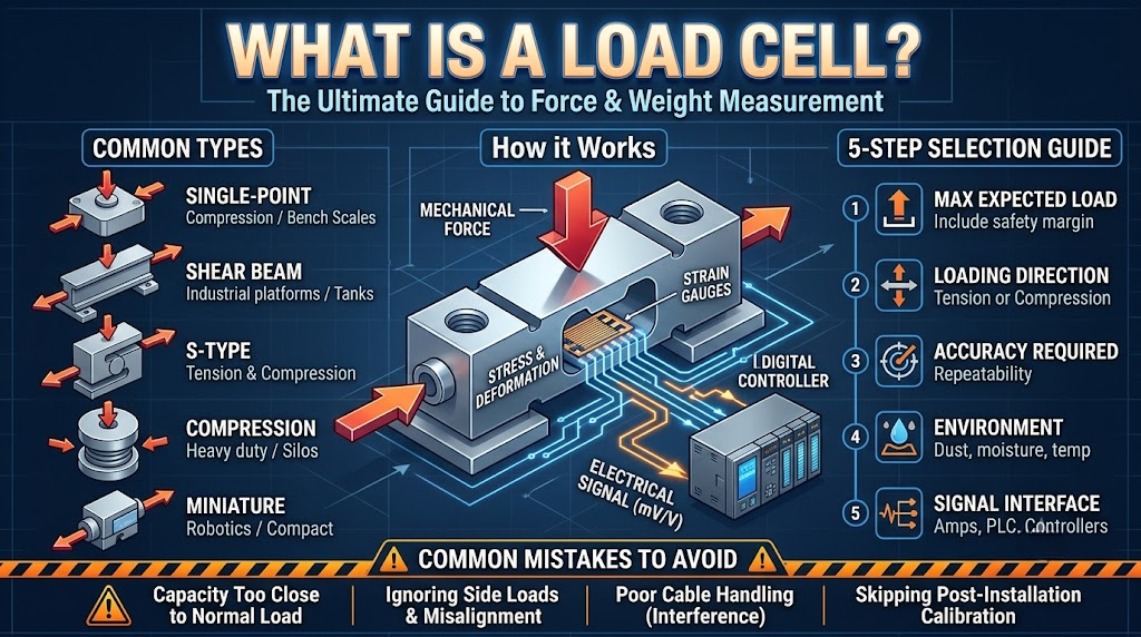
The most widely used load cells are strain gauge load cells. Inside this type of sensor, strain gauges are bonded to a precisely designed metal element. When a load is applied, the metal element deforms by a very small amount. This deformation changes the electrical resistance of the strain gauges. The resulting change is typically measured through a Wheatstone bridge circuit and converted into a low-level electrical output, usually expressed in millivolts per volt, or mV/V.
For example, a load cell rated at 2 mV/V with a 10 V excitation voltage may produce approximately 20 mV at its rated capacity. Because this signal is very small, a transmitter, amplifier, indicator, PLC input module, or weighing controller is usually required to process it.
Quick conclusion: A load cell does not simply “detect weight.” It measures mechanical force and converts that force into an electrical signal that a control or measurement system can interpret.
Who Uses Load Cells?
Load cells are suitable for engineers, machine builders, system integrators, weighing equipment manufacturers, automation professionals, quality control teams, laboratories, food and packaging companies, logistics operations, and factories that need to measure force or weight accurately. They may be used in both simple standalone weighing systems and sophisticated closed-loop control systems.
Why Are Load Cells Needed? Common Industrial Problems They Solve
Modern manufacturing requires more than simply knowing whether an object is “heavy” or “light.” Production lines increasingly need measurable data for batching, dosing, filling, quality verification, overload protection, inventory control, force monitoring, and process automation. A load cell provides the measurement input required to make these processes repeatable and traceable.
1. Electronic Weighing
Industrial scales rely on one or more load cells to determine weight. Examples include platform scales, floor scales, truck scales, hopper scales, checkweighers, bench scales, and counting scales. The load cell provides the mechanical-to-electrical conversion required for digital weight display.
2. Tank and Hopper Weighing
Instead of using level sensors alone, manufacturers can install load cells beneath a tank, vessel, or hopper to determine material quantity by weight. This can be useful when material density changes or when direct weight measurement is more reliable than level estimation.
3. Force Testing
Load cells are frequently installed in testing machines to measure compression, tension, pull force, push force, break force, insertion force, clamping force, or other mechanical characteristics. These measurements help engineers verify product quality and mechanical performance.
4. Filling and Dosing Control
In packaging and process automation, a load cell can be used to control the amount of material dispensed into a container. The weighing controller can stop a valve, pump, auger, or conveyor when the desired target weight is reached.
5. Overload Monitoring
A load cell can also act as part of a safety or condition-monitoring system. Cranes, lifting equipment, presses, fixtures, robotic systems, and structural test rigs may use load measurements to identify excessive force before equipment is damaged.
Common Types of Load Cells and Their Differences
There is no single load cell design that is ideal for every application. Different structures are optimized for different capacities, mounting methods, loading directions, space limitations, and environmental requirements. Understanding the main types makes selection much easier.
Single-Point Load Cell
A single-point load cell is widely used in small and medium platform scales. One major advantage is its ability to compensate for off-center loading within a specified platform size. This makes it suitable for retail scales, bench scales, packing machines, and compact weighing equipment.
Shear Beam Load Cell
Shear beam load cells are common in industrial weighing systems where durability and medium-to-high capacity are important. Applications include platform scales, tank weighing systems, hopper scales, conveyor weighing, and process equipment.
S-Type Load Cell
An S-type or S-beam load cell can usually measure both tension and compression. Its shape allows convenient installation between threaded rods, fixtures, hooks, or mechanical assemblies. It is commonly used in suspended weighing, material testing, force measurement, and machine monitoring.
Compression Load Cell
Compression load cells are designed primarily for downward loading. They are used in higher-capacity applications such as silos, tanks, structural tests, heavy machinery, material testing equipment, and industrial presses.
Miniature Load Cell
Miniature load cells are useful when installation space is limited. They are often found in medical equipment, robotics, laboratory instruments, assembly fixtures, compact machines, and research applications. Their small size is convenient, but installation alignment can be especially important.
Canister and Pancake Load Cells
Canister and pancake-style load cells are commonly selected for high-capacity force measurement, test machines, presses, structural monitoring, and industrial test systems. Depending on the design, they may provide good resistance to side forces and high structural rigidity.
How to Select a Load Cell in 5 Steps
Selecting a load cell based only on maximum weight is one of the most common mistakes. A reliable measurement system should consider capacity, loading direction, mechanical structure, accuracy, environment, signal requirements, and overload risk.
Step 1: Determine the Maximum Expected Load
Start by identifying the maximum normal working load, then consider the weight of containers, fixtures, platforms, tanks, piping, mounting hardware, and other dead loads. The load cell capacity should provide adequate margin without being excessively oversized.
An excessively large capacity may reduce usable measurement resolution, while an undersized load cell may experience repeated overload. Dynamic impact, shock loading, vibration, sudden material drops, and operator misuse should also be considered.
Step 2: Identify the Loading Direction
Determine whether the application measures compression, tension, or both. Also consider side loads, bending moments, torque, and misalignment. A load cell usually performs best when force is applied along its intended measurement axis.
Step 3: Define the Required Accuracy
Load cell specifications may include rated output, nonlinearity, hysteresis, repeatability, creep, temperature effect, zero balance, and combined error. The most important parameters depend on the application. A simple presence or overload detection system may not require the same precision as a batching or laboratory weighing system.
Step 4: Check Environmental Conditions
Consider water, humidity, dust, chemicals, washdown, temperature variation, condensation, corrosive environments, outdoor exposure, vibration, and electrical noise. Stainless steel construction, sealed designs, appropriate cable protection, and a suitable ingress protection rating may be required for demanding environments.
Step 5: Confirm the Signal and Control Interface
A traditional strain gauge load cell generally produces an mV/V signal and therefore requires suitable signal conditioning. Depending on the system architecture, the final output may be converted to 0–10 V, 4–20 mA, RS-485, Modbus, Ethernet-based communication, or another industrial interface.
- Calculate the real working and overload conditions
- Select the correct mechanical load direction
- Match accuracy requirements to the process
- Verify environmental protection and materials
- Confirm compatibility with the indicator, amplifier, PLC, or controller
Load Cell Selection Comparison Table
| Load Cell Type | Typical Load Direction | Common Applications | Main Advantage | Key Selection Concern |
|---|---|---|---|---|
| Single-Point | Compression | Bench scales, packaging scales, compact weighing systems | Supports off-center platform loading | Platform dimensions and capacity |
| Shear Beam | Compression | Tank scales, platform scales, industrial weighing | Robust industrial design | Mounting alignment and side forces |
| S-Type | Tension and compression | Force testing, suspended weighing, machine monitoring | Flexible force measurement | Axial alignment |
| Compression | Compression | Silos, heavy tanks, presses, structural testing | Suitable for higher capacities | Mounting structure and load distribution |
| Miniature | Depends on design | Robotics, medical devices, laboratory instruments | Compact dimensions | Installation alignment and overload protection |
Common Load Cell Mistakes to Avoid
Even a high-quality load cell can produce unstable or inaccurate results if the mechanical and electrical installation is poor. Many load cell problems are not caused by the sensor itself, but by incorrect mounting, poor wiring, unsuitable capacity, or environmental interference.
1. Selecting Capacity Too Close to the Normal Load
If the system regularly operates close to the rated capacity, an unexpected impact or overload can damage the load cell. Capacity should be selected with realistic operating conditions in mind rather than only the nominal weight.
2. Oversizing the Load Cell Too Much
The opposite problem can also occur. If a very high-capacity load cell is used to measure a small load, the useful signal may be relatively small, making it more difficult to achieve the desired resolution and sensitivity.
3. Ignoring Side Loads and Misalignment
A load cell is generally calibrated for a specific load direction. Side loads, torque, bending, rigid piping, poor mounting geometry, or uneven support can introduce measurement errors and mechanical stress.
4. Incorrect Cable Handling
Load cell cables carry low-level signals and should be routed carefully. Running sensor cables alongside high-power motor cables, inverter wiring, welders, or other noise sources can introduce electrical interference. Shielding, grounding, cable routing, and junction box design should be planned correctly.
5. Ignoring Temperature Effects
Load cell performance can change with temperature. In applications that experience large thermal changes, both the sensor specification and the mechanical structure should be evaluated for temperature-related expansion and zero drift.
6. Skipping Calibration After Installation
Installing a new load cell does not automatically guarantee correct system readings. Calibration should be performed after the complete mechanical and electrical system is installed. This allows the indicator or controller to account for the actual installation.
7. Assuming Every Load Cell Uses the Same Wiring
Wire colors are not universally standardized across every manufacturer. Always check the product datasheet for excitation positive, excitation negative, signal positive, signal negative, sense wires, and shield connections before wiring the sensor.
Advanced Load Cell Tips and Best Practices
1. Design the Mechanical Structure Before Finalizing the Sensor
The mechanical structure and the load cell should be considered as one measurement system. A precise sensor cannot compensate for poor force transfer, unstable mounting, excessive friction, rigid piping, or uneven support. Engineers should define how force reaches the sensing element before finalizing the load cell model.
2. Add Mechanical Overload Protection When Needed
In systems where operators may drop products onto a weighing platform or where machines can generate sudden force, mechanical stops can reduce the risk of damaging the sensor. Overload protection is particularly important for low-capacity or miniature load cells.
3. Calibrate the Entire Measurement Chain
Calibration should account for the load cell, mounting hardware, junction box, transmitter, amplifier, indicator, PLC input, and software scaling. Treating only the sensor as the measurement system can overlook errors introduced elsewhere in the chain.
4. Record Zero and Span Performance Over Time
For critical applications, periodic records of zero balance, test weight results, repeatability, and calibration changes can help identify gradual mechanical or electrical problems. Trending these values can make preventive maintenance more effective.
5. Match the Load Cell to the Real Environment
A load cell used inside a clean laboratory does not face the same conditions as one installed under a food-processing hopper, on an outdoor truck scale, or beside a chemical process line. Material, sealing, cable protection, cleaning methods, temperature range, and corrosion resistance should be selected according to the actual installation environment.
Conclusion: How to Build a Reliable Load Cell Measurement System
A load cell is one of the most important sensing components in modern weighing and force measurement systems. It converts mechanical force into a measurable electrical signal and allows machines to monitor weight, force, tension, compression, batching, filling, loading, and process conditions.
However, selecting a load cell is not simply a matter of choosing a capacity. A reliable system depends on the relationship between sensor capacity, load direction, mechanical installation, environmental conditions, accuracy requirements, signal conditioning, cable routing, calibration, and overload protection.
For a new project, begin by defining the real operating load and mechanical structure. Then identify whether the application requires compression, tension, or both. After that, compare accuracy specifications, environmental protection, material construction, electrical output, and controller compatibility. This process makes it much easier to select a load cell that fits the actual machine instead of simply choosing a sensor based on price or capacity.
Next Step: Before requesting a load cell quotation, prepare the required capacity, force direction, platform or fixture dimensions, accuracy target, installation environment, output signal, operating temperature, and controller type. Providing these details allows suppliers or engineers to evaluate the application more efficiently.
Load Cell FAQ
Q1: What is a load cell used for?
A load cell is used to measure mechanical force or weight and convert it into an electrical signal. Typical applications include electronic scales, tanks, hoppers, filling machines, test equipment, presses, automation systems, and industrial force monitoring.
Q2: How does a load cell work?
A strain gauge load cell works by allowing a metal sensing element to deform slightly under force. Bonded strain gauges change resistance during this deformation, and the electrical change is converted into a signal proportional to the applied load.
Q3: What is the output signal of a load cell?
Traditional strain gauge load cells commonly provide a low-level mV/V output. A transmitter, amplifier, weighing indicator, or controller may then convert this signal into a usable voltage, current, digital value, or industrial communication format.
Q4: How do I choose the correct load cell capacity?
Calculate the maximum working load, including platforms, fixtures, containers, and dead load. Then consider shock, vibration, dynamic loading, and overload conditions. Capacity should provide a reasonable safety margin without being unnecessarily oversized.
Q5: What is the difference between compression and tension load cells?
Compression load cells measure forces pushing onto the sensor, while tension load cells measure pulling forces. Some designs, such as many S-type load cells, can measure both tension and compression when installed correctly.
Q6: Why does a load cell need calibration?
Calibration establishes the relationship between the electrical signal and the actual applied load. It also accounts for the complete installed system, including mechanical mounting, signal conditioning, indicator scaling, and other components that can influence the final reading.
Q7: Can a load cell be overloaded?
Yes. Excessive force can cause permanent zero shift, loss of accuracy, structural deformation, or complete sensor failure. Dynamic impacts can be especially damaging, so mechanical stops or overload protection may be needed in some machines.
Q8: Can load cell cables be extended?
Cable extension may be possible, but it should be done according to the sensor and instrumentation requirements. Cable resistance, shielding, sense wires, junctions, electrical noise, and calibration may all affect measurement performance.
Q9: What causes unstable load cell readings?
Unstable readings may result from vibration, mechanical friction, side loading, loose mounting, electrical interference, poor grounding, damaged cables, moisture, unstable excitation voltage, temperature changes, or incorrect signal filtering.
Q10: How often should a load cell system be calibrated?
There is no single calibration interval suitable for every application. Frequency depends on accuracy requirements, usage intensity, environmental conditions, regulatory requirements, overload history, and the stability of previous calibration records.